Advertorial in partnership with Jumpspeak.
The Shocking Benefits to Your Brain When You Learn a New Language After 40 — and the One Reason Almost Every Adult Misses Them
Debunking the biggest myth about adults learning a new language.

There is a growing pile of neuroscience research that should be front-page news, and for some reason isn't.
It says the thing you've been told your whole life about the aging brain — that it hardens, that it stops learning, that the window for a new language slammed shut in your twenties — is wrong.
Not "mostly wrong." Wrong in a way that has real consequences for how sharp your mind stays into your seventies and eighties.Here is the finding that stopped me cold. Adults who learn a second language later in life don't just acquire a skill.
Their brains physically change — structures grow, connectivity strengthens — and those changes correlate with measurably better memory, sharper attention, and a lower long-term risk of dementia.
So here is the question this article is really about: if the science is this clear and the payoff is this large, why do the overwhelming majority of adults who try quit within months, convinced they're simply too old?
The answer isn't age, and it isn't ability.
It's a specific, fixable mistake almost every adult makes without knowing it — one the most popular language apps quietly depend on you making. By the end of this you'll know exactly what it is, and what the research says works instead.
The Most Striking Study
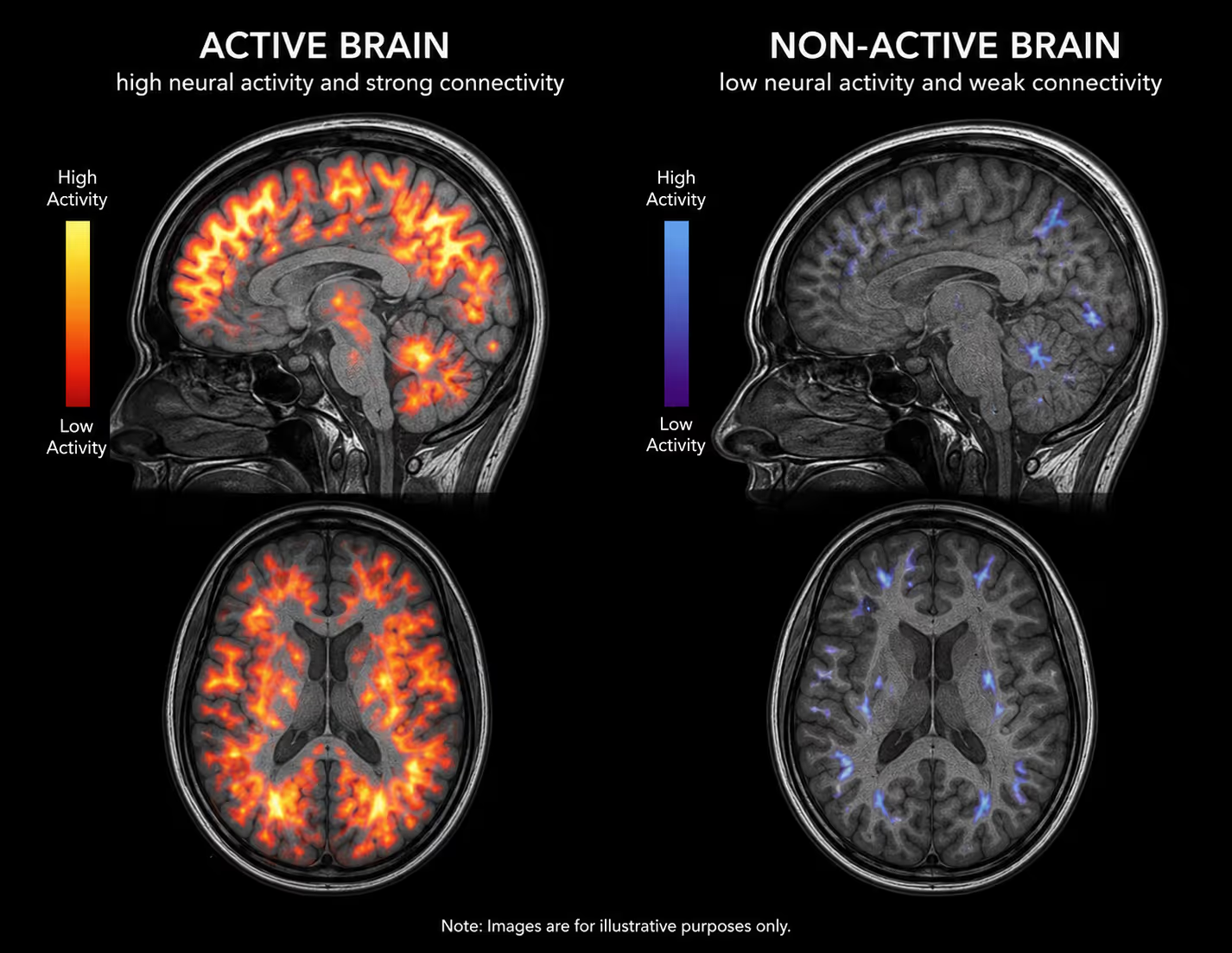
The single most striking finding of the last fifteen years is that adult language learning produces visible, physical changes in brain structure — growth you can see on an MRI.
In 2012, researchers at Lund University in Sweden scanned young military interpreter trainees before and after thirteen months of intensive language training. As a control, they scanned medical students studying just as hard, just as many hours, at unrelated material. The language group showed measurable growth in specific regions — the hippocampus, the superior temporal gyrus, the middle frontal gyrus, the inferior frontal gyrus. The medical students, grinding through equally punishing coursework, showed no comparable structural change at all.
Read that again, because it's the hinge of this whole article. Two groups. Same intensity. Same hours. Same discipline. Only one group's brains physically grew — and it was the group learning to speak. The brain didn't just store a language. It rebuilt itself around the act of producing one.And that rebuilding is exactly what protects the brain as it ages.
The same active engagement that grew those regions is tied, in study after study, to cognitive reserve — the brain's ability to keep functioning even as it ages, and to resist the decline that leads to dementia. Bilingualism research has repeatedly found that people who actively use a second language show the first symptoms of Alzheimer's and other dementias years later than people who don't — even when the underlying disease is equally advanced.
The language didn't stop the disease. It built enough reserve that the brain could work around the damage for longer.
Here is the detail that decides everything: the protective effect is tied to active use — to production — not to passive knowledge. Recognizing words does little. Using the language — speaking it, producing it under real-time pressure — is what builds the reserve.
Which means the way the average adult "learns" a language, silently tapping and reading and never speaking, may be building almost none of the protection that made this research exciting in the first place.
Debunking The Adult Brain Myth
The persistent myth that adults can't learn languages traces back to a real piece of research — but a piece that has been widely misinterpreted.
Eric Lenneberg's 1967 book Biological Foundations of Language proposed that there was a critical period for language acquisition that closed around puberty, after which true native-like fluency was effectively impossible. For decades, this hypothesis was treated in popular culture as established fact.
What the research has subsequently shown is far more specific. The "critical period" appears to apply primarily to two narrow components of language: phonological accent (sounding like a native speaker) and certain aspects of grammatical intuition. It does not apply, as a matter of empirical fact, to vocabulary acquisition, conversational fluency, reading comprehension, or functional communication.
Adults who begin learning a second language after 40 can reach high levels of functional fluency. They typically retain a foreign accent. They may make occasional grammatical errors that native speakers wouldn't make. They will not, in most cases, become indistinguishable from native speakers.
But they can become fluent enough to hold real conversations, read literature, conduct business, fall in love, raise children bilingually, and develop genuinely deep cultural understanding. The myth was never that adults couldn't reach native-level pronunciation. The myth was that adults couldn't become functionally fluent — and that part of the myth was always wrong.
This is the gap that newer language acquisition tools have been built to address. An app called Jumpspeak, for example, is specifically designed around adult production training — daily, AI-driven conversational practice with real-time pronunciation and grammar feedback. The structure mirrors what the research suggests works: high-volume spoken output, sustained over months, with corrective feedback. Twenty minutes a day of actual speaking, the research suggests, is more effective for adult fluency development than two hours of traditional study.
.png)
What This Means in Practice
For an adult considering whether to begin a second language at 40, 50, or 60, the research supports a few specific conclusions:
The structural neurological benefits are real, measurable, and available at any age. They are not limited to childhood acquisition. They require sustained engagement, particularly with active speaking.
The cognitive reserve benefits — including reduced long-term dementia risk — are most pronounced in adults who use the language regularly over years. The protective effect appears tied to active use, not passive knowledge.
Fluency is achievable, but accent is rarely native-like. Most adults will retain some foreign accent. This does not impair functional communication.The methodology matters more than the time invested. Adults who spend most of their language-learning time on speaking practice progress significantly faster than those who spend most of their time on reading and vocabulary, even at equal total hours.
The window for these benefits doesn't close at any specific age. The relevant variables are sustained practice, active production, and the willingness to engage in the somewhat uncomfortable work of speaking a language imperfectly until imperfectness gives way to fluency.
For adults who have been telling themselves they're "too old" to start, the research is unambiguous: the brain is more plastic than mid-twentieth-century neuroscience believed, and the cognitive payoff of language acquisition extends well beyond the language itself.
The brain you have at 40, 50, or 60 is capable of changes you may have been told were impossible.
The research suggests you should probably start.
Try Jumpspeak for yourself
TRY 100 DAYS

I am loving Jumpspeak! Within a week of using it, my Spanish comprehension is improving. The unique thing about this app is that it creates a life-like conversation where you listen, then respond. Just like a real conversation, with AI feedback.

Daniel Dirk

Jumpspeak is something I wish existed for awhile. I first tried Duolingo and it lacked real use cases. With Jumpspeak, you can actively practice real-life conversations, which I must say is a very effective way to learn. I highly recommend Jumpspeak!

Sébastien Lamanna
I used to feel shy & intimidated speaking French to strangers. Jumpspeak has helped me feel more confident within the first month, and it is the best thing I've found to learn a new language. So many other apps use traditional methods, but don't help you speak it.
Yvette Nichols
I tried many different language apps in the past, but I couldn’t speak fluently. Jumpspeak is different because it actually lets me talk and respond like real conversations. After 3 weeks, I already feel more comfortable introducing myself and asking questions in English.
.jpg)
Wendy Wong 🇨🇳
"I went from B1 (Intermediate) to C-level (Advanced) after using Jumpspeak. I saw an immediate difference."
-Jazmine Kempin
"I started as a beginner, and now I can confidently say I'm an Intermediate speaker. This is 100% thanks to Jumpspeak."
-Mark Holmes
"I've honestly tried every language app out there, but Jumpspeak is the most innovative, natural, and conversation-based app I've ever used."
-Dr. Leslie Lundt, MD
AS SEEN ON
The Fluent Report is operated by Growth Studio, LLC. This is advertorial content produced in partnership with Jumpspeak. Individual results vary. Information on this site is for educational purposes and should not be interpreted as medical, legal, or financial advice. By using this site, you agree to our Terms of Service and Privacy Policy.